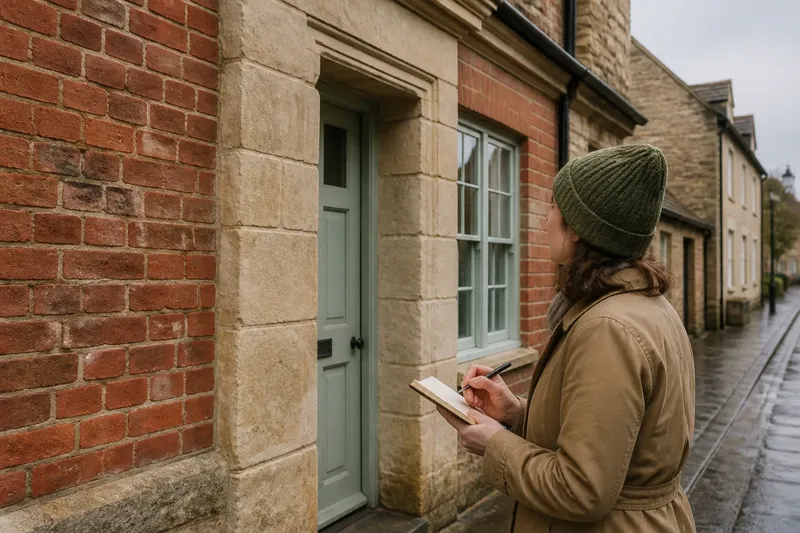
A Pocket Walk for Noticing Local Building Details
A pocket walk for noticing local building details helps you record how a street’s buildings relate to local character, without guessing at their history.
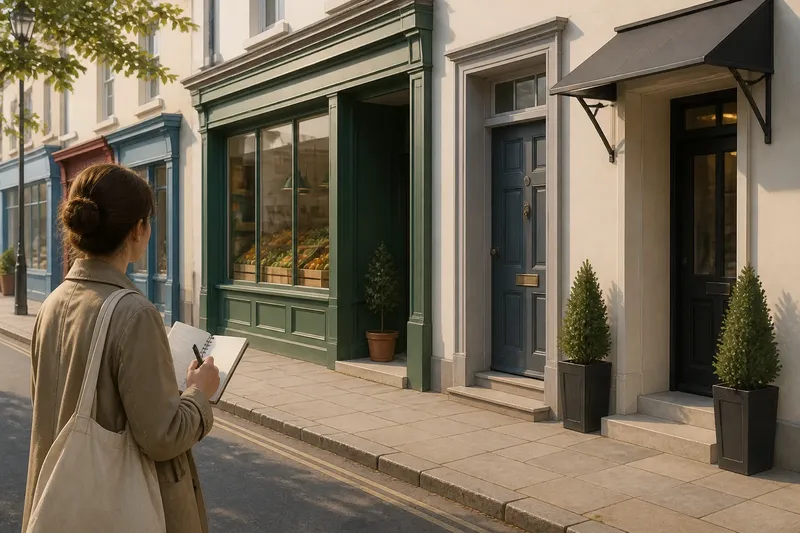
You pause beside a corner shop and notice its entrance sits farther back than the doors next to it. A pocket walk for noticing local building details turns that small difference into a way to see how buildings give a street its particular character and connect it to nearby places.
The aim is not to identify a style or explain a building’s past from a sidewalk view. Instead, record visible features and their relationships: how entrances meet the sidewalk, how signs sit above shopfronts, or how one building’s outline differs from its neighbors. Those observations can suggest questions about local character without pretending to answer them.
How can building details express a place?
A building is part of a street scene, not an isolated object. The height of a ground-floor window, a covered entrance, or a sign positioned for people walking past can shape how a building meets the public street.
Repeated forms may also make one block feel related to another, while a distinct doorway or storefront marks a local variation. These patterns are useful observations, but they do not by themselves establish when buildings were made, who designed them, or why a feature appears.
Keep the distinction clear: describe what is visible first, then treat any question about regional history as a question to check against reliable local sources. That lets a notebook capture both the street’s character and the limits of a sidewalk view.
How do you choose a short route?
Choose one publicly accessible street where you can walk and pause without blocking doors or sidewalks. A familiar block can reveal details you usually pass over; an unfamiliar one may make contrasts easier to notice.
Set a boundary, such as one side of a block between two corners, and decide where you will turn back. Stay on public sidewalks, avoid entering courtyards or buildings, and do not aim a camera into private interiors. If the street is busy, keep moving until you can pause safely.
A small route gives you time to notice relationships among buildings rather than spending the walk searching for the next destination.
What should you record about each building?
Write a location and a plain description, then note how the feature relates to the sidewalk or neighboring buildings. You do not need architectural vocabulary; ordinary words can be precise when they name a position, shape, or visible contrast.
- Entrance: Check whether the door sits flush with the facade or is set back; if the difference is visible, record its position, otherwise leave the depth unjudged.
- Street-facing windows: Check their arrangement in relation to the entrance; if they form a clear repeated pattern, describe it, otherwise note only the windows you can see.
- Shopfront: Check how the display window and doorway meet the sidewalk; if one is recessed or separated, describe that relationship, otherwise avoid inferring how the interior is used.
- Signage: Check where a sign is placed on the facade; if its position is clear, record it, otherwise skip guesses about its original purpose.
- Covered edges: Check for a visible canopy, porch, or projecting roof edge; if it is unobstructed, note where it meets the entrance, otherwise record the obstruction or choose another feature.
- Neighboring buildings: Check for a visible contrast in height, openings, or entrance position; if there is one, describe the difference, otherwise record a repeated feature without explaining its cause.
Use a notebook or your phone’s notes app. A photograph can help you relocate a feature, but write a short description and location first so the image does not have to carry the whole record.
How can you keep a detail walk connected to regional character?
Look for relationships rather than treating each facade as a separate puzzle. A row of similar shop entrances, a change from storefronts to residential doors, or a covered walkway that continues across neighboring buildings can help describe how the street is organized.
Such observations can point toward useful follow-up questions: Do nearby streets use similar arrangements? Does a public map or local archive describe the area’s development? Keep those questions separate from the notes; a visible pattern is not proof of a shared origin.
Say you walk a short block with a grocery, an apartment entrance, and a small office. You note that the grocery door is recessed behind its display window, the apartment entrance is flush with the sidewalk, and the office has a narrow canopy above its door; you then write that two neighboring storefronts also have recessed entrances. The result is a specific record of how entrances meet the street, plus a question about whether that pattern continues nearby—not a claim about why it began.
What can a sidewalk view tell you?
Can I name a building style from one feature?
A single visible feature rarely tells the whole story, so describe its position and appearance instead of assigning a style. If a label interests you, check it later against a dependable local or architectural source.
How do I record a feature partly hidden by a tree?
Write what is visible and name the limit, such as “upper window partly hidden by branches.” If you cannot see enough to describe the feature, leave it out or view it from another public spot.
Should I photograph every detail?
No. A concise note may be easier to revisit than a folder of similar images. If you take a picture, connect it to a location note and follow posted restrictions and local rules.
What if neighboring buildings look alike?
Record the repeated feature, such as similarly placed entrances, without concluding that the buildings share an age or history. If that question matters, seek separate evidence rather than relying on appearance alone.
How do you avoid turning observation into a guess?
Use words that describe what can be seen from a public place. A shadow may resemble a recess, a dark window may reflect the street, and a painted surface may be hard to distinguish from another material at a distance.
For example, “a smooth rectangular patch below the window” is a visible description. A claim that the patch is a repair from a particular period needs evidence beyond its appearance.
Record conditions that limit your view: a parked vehicle hiding the lower wall, scaffolding covering an entrance, or low light obscuring a small fitting. Do not move objects or cross barriers to complete the view; choose another visible feature if needed.
How should you finish the walk?
Before leaving the street, check that each note identifies a place and describes something you could point to. Add the walking direction or starting corner so you can return to the same stretch, and keep any unanswered questions separate from the observations.
Later, compare notes from another public walk or consult a reliable local source if a pattern raises a question about the area’s character. The pocket walk for noticing local building details is most useful when its record makes both the visible connections and the limits of what you know easy to see.
On your next pass, look for one detail that changes the way a building meets the sidewalk. A single well-placed note can make a familiar street easier to read without turning it into a story you cannot yet support.